
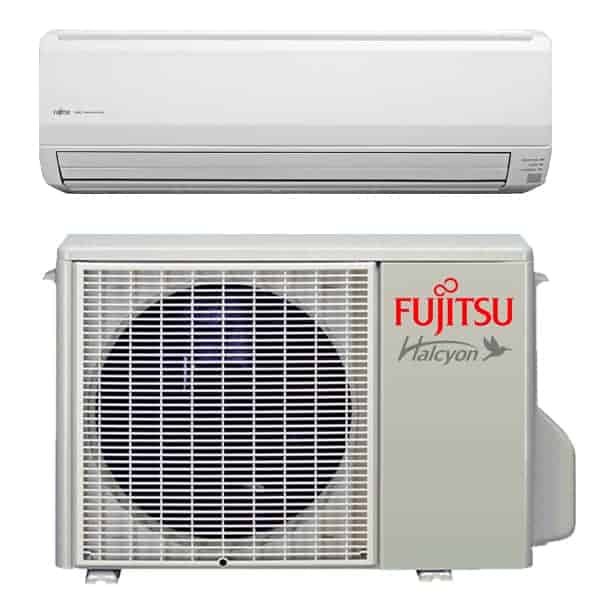
Fujitsu wall mounted Heat Pump
As quiet as 21dB, Fujitsu wall-mounted heat pumps can be installed in any space of your home because they make no noise. Continuous ventilation will ensure your comfort throughout the year thanks to the low and high speed mode.
- Description
- Reviews (0)
- Brochure
Description
Wall-mounted heat pump buying guide (2021 updated)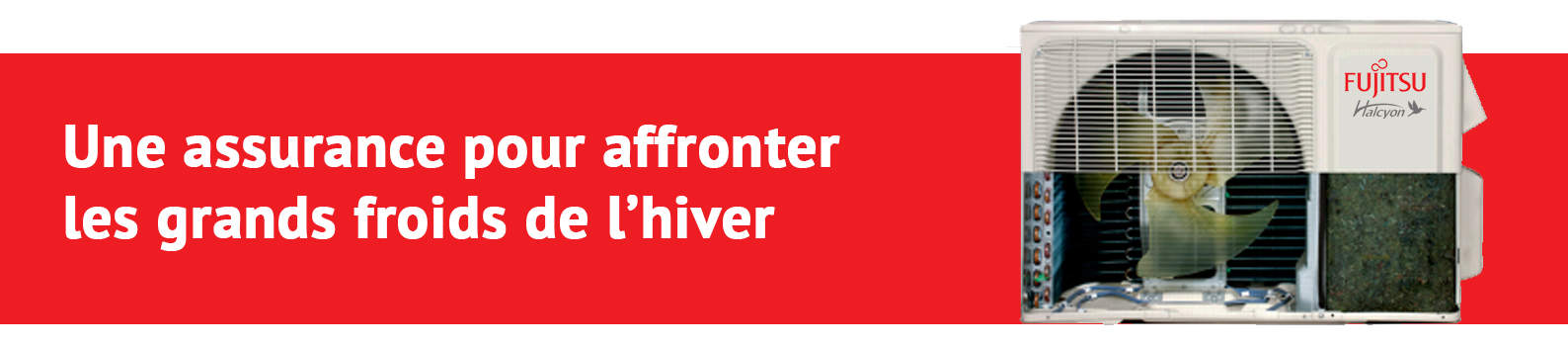
The manufacturing quality of the heatpump and the supplier’s service
The product
Nowadays, all the major manufacturers of wall-mounted heat pumps manufacture entry-level and high-end products. Manufacturers established in Quebec and Canada who have sold their air conditioners for several years are very familiar with the Quebec climate. Many new products sold in large volumes worldwide have great difficulty when they arrive in Quebec with their products, because these are not the same conditions as in Europe or Asia. Mechanical parts and electronic cards are not designed to withstand our winter climate and this creates major short-term operating problems. Some brands have a very good global reputation, but they don’t have experience with our extreme temperatures. Here are the main brands of wall-mounted heat pump that have been established in Quebec and Canada for more than 15 years (wall-mounted air conditioner only): Fujitsu, Mitsubishi, LG, Haier, Keeprite and Carrier
The distribution network
Here is how your wall heat pump arrives (no wall heat pump is manufactured in America they are all Asian manufacturers such as Japan, South Korea, Malaysia and China, etc …): The manufacturer (Fujitsu, Mitsubishi, LG, etc.) manufactures the product and sells it to the distributor / supplier (approximately 2 months by boat to arrive in America). The distributor / supplier (Wolseley, Master, etc.) sells the product to the entrepreneur (in this case MPH companies). The entrepreneur sells the product to the consumer. It is also very important when choosing products to prioritize a supplier as well as an entrepreneur with quick after-sales service, with good technicians and many distribution points so that they are able to supply you with parts. in case of breakage. Certain device has 12 year warranties, however if the supplier does not have the spare part in stock during a heat wave, needless to say that your 12 year warranty will air condition or heat your home if your device no longer works . Distributors specializing in air conditioning and heating have many spare parts in stock in order to provide replacement parts in the event of breakage, and this within 24 hours. Some products have a very good reputation, but the distribution network and inventory are poorly managed. The 2 distributors / suppliers in Quebec with the best service and the largest parts inventory are:
Wolseley: with more than 25 branches, specialize in air conditioning, heating and ventilation across Quebec (LG brand distributor and Keeprite https://www.wolseleyexpress.com/branch-locations
Master: with more than 19 branches, specialize in air conditioning, heating and ventilation across Quebec (distributor of the brand Fujitsu, Haier and Gree) https://www.master.ca/fr/etablissement/
The power of your wall-mounted heat pump

Comfort above all
Above all, a too powerful wall heat pump will carry out cooling cycles too fast, this will cause your house to cool too quickly and prevent good moisture evacuation. The principle of air conditioning in a house is not only to lower the temperature to the desired set point, it is also necessary to lower the relative humidity between 40% and 50% to obtain optimal comfort. It is very important to understand that an ambient temperature of 20 ° C with a relative humidity of 70% is not at all comfortable (it creates a feeling of wet cold). If your air conditioner is too powerful for the size of your home, you will find yourself in this situation. When you do your research for a wall-mounted heat pump, it is even more important to take into account the configuration of the rooms in your house than the square foot of living space. Many people get poor advice from salespeople who are unfamiliar with the basics of air conditioning.
The localisation
The best example for this situation is the 2-storey cottage type house (basement, ground floor and 2nd floor). Normally, these houses will have between 700 and 800 square feet per floor (if we add up, this gives between 1400 and 1600 square feet in total). Too often, the units sold in these homes will be 15,000 Btu / hr or 18,000 Btu / hr heat pumps, but that is a serious mistake. Your heat pump is installed at the highest point of your stairwell and the area of the 2nd floor is approximately 800 square feet, the 15,000 Btu appliance will be too powerful and it will carry out cooling cycles too fast and it will lower the temperature too quickly, this will result in poor dehumidification. An air conditioning unit of 12,000 Btu / h will be too small if we add the 2 stages it is true, but it will do a better job than an appliance of too large capacity, because it will lower the temperature and the humidity rate to the same speed (the 2 important variables). The best solution in this type of house would be to install 2 devices of 9,000 Btu / h or 12,000 Btu / h. However, this option can sometimes exceed the budget that you set at the start. Generally in 90% of cases, 2-story houses will be very comfortable with a 12,000 Btu / hr device well positioned in your stairwell. The device must also have a sufficient number of CFM “Pied Cube per Minutes” (fan power) to give you comfort with more or less 2-3 ° C of difference with the 2nd stage (which is very acceptable). The following parameters must also be kept in mind: the windows, the level of sunshine and the insulation of the house. The table below will guide you in assessing the power you need, depending on the area to be air conditioned: This quick selection table has been used by our company for more than 15 years and it is based on heat load calculations for a standard 1-storey open air house (bungalow):
Wall mounted heatpump power based on square feet
| Power | Area to be conditioned |
| 9,000 BTU/h | 550 to 850 square feet |
| 12,000 BTU/h | 850 to 1150 square feet |
| 15,000 BTU/h | 1150 to 1450 square feet |
| 18,000 BTU/h | 1450 to 1750 square feet |
| 24,000 BTU/h | 1750 to 2050 square feet |
The wonderful energy efficiency ratings (HSPF, EER and SEER)
What is SEER and how is it calculated?
The term SEER stands for Seasonal Energy Efficiency Rating (English version). In French, you will find the abbreviation TRÈS which stands for Seasonal Energy Efficiency Rate. The SEER is an energy efficiency rating or ratio and all devices are rated based on their performance. In other words, the higher the SEER, the less energy your heat pump will consume in cooling mode. However, it is important to understand that SEER is only a means of measurement for “air conditioning” and is not effective for heating mode. SEER energy efficiency is the ratio of the air conditioning power (BTU / h) divided by the gross energy consumption of the device (kWh or Watt / h). This is the average for an air conditioning season and is calculated using an indoor ambient temperature of around 20 ° C and an outdoor temperature of 28 ° C. So if the average outdoor temperature in the area you live in is above or below 28 ° C during the summer, the SEER efficiency will not be the same. All air conditioning units have a seasonal energy efficiency rating and it should be displayed on the unit’s Energy Guide label (yellow). Since 2015, manufacturers are no longer allowed to manufacture air conditioning units with an energy efficiency rate below 14.5 SEER.
SEER of 13 (lowest efficiency and no longer eligible to be sold) SEER of 33 (highest efficiency Fujitsu RLS3 and RLS3H model) SEER of 40 (highest efficiency Keeprite DLCPRA model) *** Please note that the difference in annual energy consumption between a device with a SEER of 33 and a device with a SEER of 16 will be approximately $ 30, since your air conditioning unit will only be used 2-3 months being given our Quebec climate with about 2-3 months of heat and 8-9 months of cold. The SEER is a point to consider, but it is not the most important criterion in Quebec *** 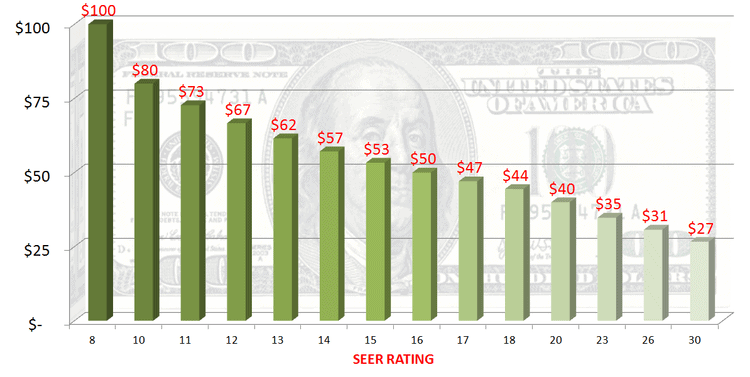
What is the EER and how is it calculated?
The term EER means Energy Efficiency Ratio (English version). In French, you will find the abbreviation TRÉ which stands for Rate of Energy Efficiency. The EER is calculated using an outside temperature of 35 ° C, a temperature of 26 ° C inside and a level of 50% humidity. No seasonal temperature change is taken into account in the rating of a unit’s EER.
The difference between EER and SEER
If you observe on a technical sheet the SEER value of an air conditioner, then you know that the SEER is a good projection of the energy efficiency of your device if the average summer temperature in your region is 28 ° C, but it may be different if you live in Texas or in very hot regions. However, the EER value is a standard efficiency rate that can be used to directly compare air conditioners without worrying about temperature differences. The EER compared to the SEER is mainly used by air conditioning technicians to obtain real information on the general performance of the wall-mounted heat pump. In other words, the EER is used by engineers and technicians and the SEER is often used for marketing. The EER is actually an energy efficiency rating or ratio that devices have and is evaluated based on their performance. So the higher the EER, the less energy the device will consume. Energy efficiency EER is the ratio between the cooling power (BTU / h) divided by the gross energy consumption of the device (Watt / h or kWh).
EER of 8 (lowest efficiency) EER of 18 (Best efficiency in 2020 model Fujitsu RLS3 and RLS3H)
What is HSPF and how is it calculated?
The abbreviation HSPF stands for Heating Seasonal Performance Factor (English version). In French, you will find the term FRSC which means Seasonal Efficiency Factor in Heating. The HSPF is actually a ratio or rating of energy efficiency and each device is evaluated according to their heating performance. In other words, the higher the HSPF, the less energy the device will consume in heating mode. However, it is important to understand that the HSPF is only a means of measurement for “heating” and is not applied for data in air conditioning. The HSPF energy efficiency is the ratio between the heating power in (BTU / h) divided by the gross energy consumption of the device (kWh or Watt / h). The HSPF is the average for a heating season and is calculated using an indoor ambient temperature of around 20 ° C and an outdoor temperature of 8 ° C. All heat pumps have an energy efficiency rating for the heating season and it should be displayed on the Energy Guide sticker (yellow). *** Please note that a device with an HSPF of 14 can save you up to $ 500 in savings on your annual heating bill compared to a device with an HSPF of 9 will save you up to $ 200 on your annual heating bill (this takes into account the energy consumption for the months of air conditioning) it is for this reason that the HSPF is much more important when you buy a heat pump considering the Quebec climate which has more months of heating than months of air conditioning *** 
What is HSPF and how is it calculated?
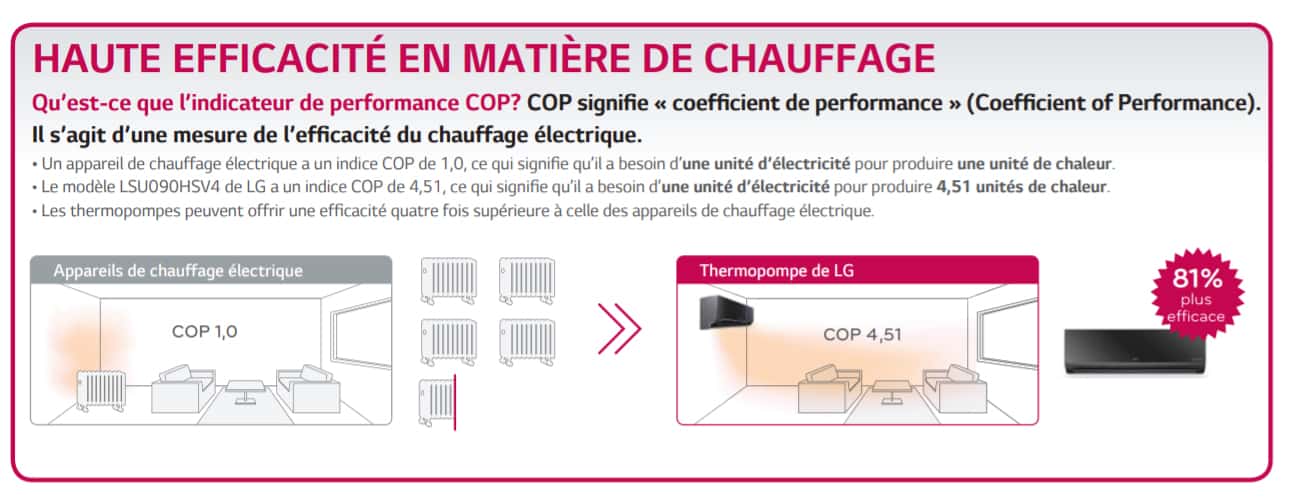
If you are looking for a wall or central heat pump, you have probably heard the word or abbreviation COP. The term COP stands for Coefficient of Performance. The COP is actually a ratio of energy consumption versus the amount of heat produced by a heat pump or other device. Each device is evaluated according to their heating performance using the COP. In other words, the higher the COP, the more the device will give you heating power in heating. Now, it is important to understand that the COP is only a means of measuring the efficiency of your heat pump for “heating” and is not applicable for air conditioning data from air conditioners. The energy efficiency COP is the ratio between the maximum heating power in (kW / h) divided by the gross energy consumption of the device (kW / h). This calculation can be used regardless of the outside temperature. Generally manufacturers will indicate performance at the following temperatures: 47ºF (8.3ºC), 32ºF (0ºC), 17ºF (-8.3ºC) and 5ºF (-15ºC). Each temperature has a different COP because the heat pump is affected by the cold outside. So it is normal for a heat pump to have a lower COP at low temperature. Example: A heat pump has a COP of 3 at an outside temperature of 17ºF (-8.3ºC). This means that your heat pump will consume (1 kW / h) for a heating power of (3 kW / h). Here’s why heat pumps are so effective at saving energy in heating. All heat pumps have COP but some manufacturers do not display their technical data.
Are HSPF and COP so important?
The answer is yes, because we are in Quebec and we unfortunately have more months of heating than air conditioning. At first glance, the meaning of HSPF and COP does not mean much, but if you compare the different rates, there can be a huge difference in energy consumption between heaters over a lifetime of several years. However, it is very important to weigh the costs of acquiring the device against the long-term profitability of the device. It is obvious that you do not need to buy a wall heat pump with an HSPF of 12 or more if you intend to move within 2-3 years, because it is the next owner of your home who will benefit from the energy saving of your heat pump. If you plan to stay in your home for several years, purchasing a heat pump with a high energy efficiency rate will have several benefits on your energy consumption. First, a heat pump with an HSPF greater than 11 and + will consume much less energy to produce the same amount of heat compared to a device that has an HSPF of 9. Second, wall heat pumps with an HSPF and a high COP, its usually considered as “high end” devices so your device will also have a high SEER which will save you for the air conditioning season (what is the SEER ?). Third, devices with a high HSPF are generally manufactured by industry recognized manufacturers who have many years of experience in the design and manufacture of wall-mounted heat pumps. To obtain an elevated HSPF, manufacturers must use the best parts and components in order to obtain high performance yields. So this assures you that your device is built with high quality materials. Finally, buying a heat pump is not child’s play, especially because of their acquisition costs. It is therefore important that you are well advised according to your needs, your current / future situation and your budget.
What is inverter technology?
 The word “Inverter” is a technology that allows the compressor to vary the cooling power of your air conditioning system. The vast majority of wall heat pump systems today have Inverter technology and here is why:
Temperature accuracy inside your home
Thanks to the variation in compressor power, the temperature will be more stable, because the temperature sensor located inside the evaporator will indicate to the compressor the power required to heat or cool your home.
Increased energy savings
The compressor considerably reduces its power when the temperature is reached and gives you only the BTU / h necessary to maintain the temperature.
Better dehumidification
A wall mounted heat pump with a good capacity Inverter compressor will be able to heat your home with longer heating cycles, this will give you better humidity and a more constant temperature.
Extended service life
Variable speed compressors last much longer because it almost never stops. Instead of stopping completely, the compressor will reduce power to provide only what is needed. This allows the compressor to always be cooled to the right temperature and to last longer.
Much quieter compressor
A wall-mounted heat pump with an inverter compressor will be much quieter than a heat pump with an ON / OFF compressor, because the compressor starts slowly and increases the speed gradually to maximize energy consumption. This allows the oil to circulate better and avoid knocks on start-up, thus being quieter when your air conditioner is running.
The operation of an inverter compressor
The frequency modulator communicates with the interior temperature sensor located in the evaporator and this allows the compressor speed to be varied. The compressor is specifically designed to operate at different speeds to modulate the heating power according to the requested temperature. A precise amount of refrigerant is a critical requirement to ensure the life of the compressor. Appropriate oil management thus ensures proper lubrication for low speed operation and prevents excessive injection of oil into the circuit when operating at full speed.
Important purchase criteria for a wall-mounted heat pump
Prioritize a heat pump with a self-cleaning function
When your heat pump turns off, the indoor fan continues to run until the evaporator is completely dry, this ensures your device will always stay clean, free from fungus and mold.
Anti-corrosion treatment of the indoor and outdoor unit
Make sure your heat pump is treated with an anti-corrosion coating that prevents the formation of oxidation (rust) on the outdoor and indoor unit. This promotes lasting efficiency and will extend the life of the coils, helping to prevent corrosion caused by surrounding pollutants.
Protection of refrigerant leaks
Good quality units have a module that protects the compressor from overheating if a refrigerant leak is detected.
Heat pump with heating element
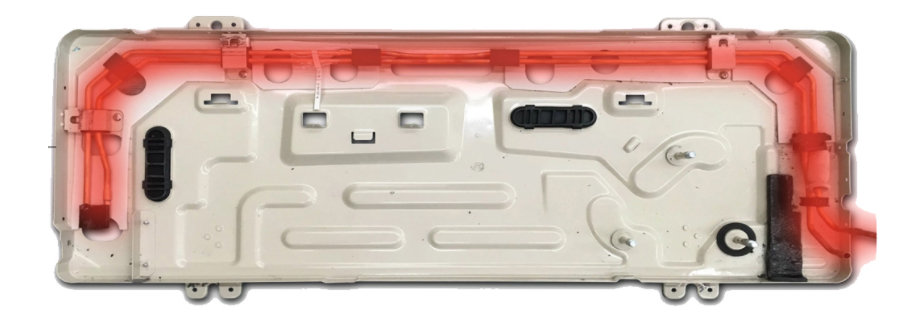
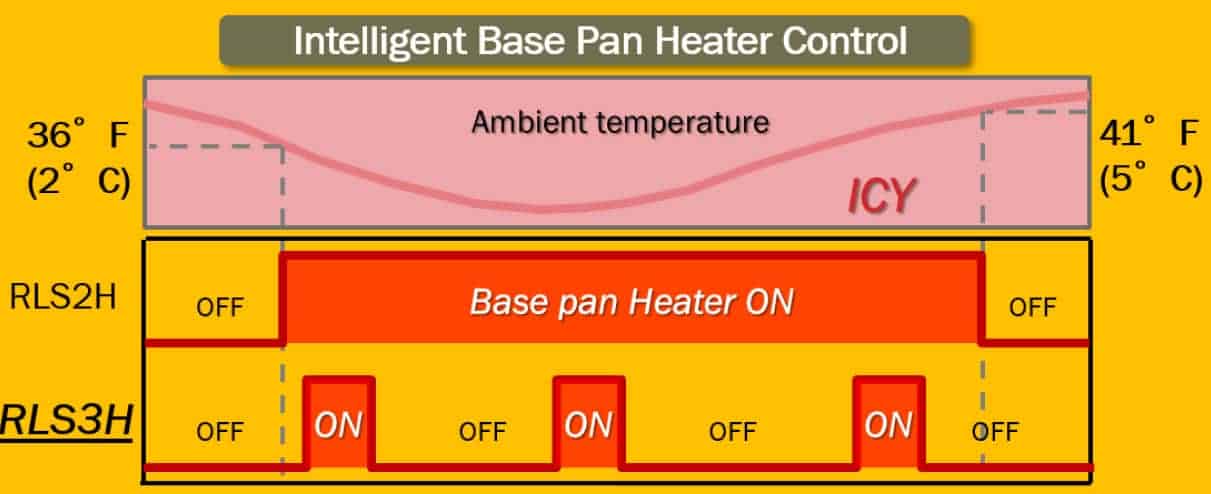
When the temperature drops below freezing, the heating element installed at the bottom of the condensing unit heats the base of the outdoor unit to prevent freezing of the condensate. Without a heating element, frozen water can cause noise, damage the outdoor unit and fan blades, and reduce the performance of the system.
The noise level of your wall-mounted air conditioner
When you compare the data sheets of the different devices, there are 2 sound variants to check: The sound level of the indoor unit (evaporator): The indoor unit called “evaporator” has between 3 and 8 fan speeds. Each ventilation speed must be entered on the technical sheet with the air flow (CFM) and the noise level (dB). The quietest unit at the moment is the LG Prestige model with (17 dB) for the indoor unit. The sound level of the outdoor unit: The outdoor unit called “condenser” has no speed, because it is generally a variable speed fan motor which communicates with the “inverter” compressor according to the required heating power. The operating noise in (dB) will then be entered at the highest speed in the technical sheets. The quietest units at present are the LG Prestige model and the Fujitsu RLS3 and RLS3H model with (43 dB) for the outdoor unit.
The price of wall-mounted heat pumps
We strongly advise you to call on companies that have been in business for several years and that are well established: office, showroom and warehouse. This will give you a guarantee that these companies will be able to give you service throughout your guarantee. The prices will be a little more expensive, but you will be sure to get a good quality of installation performed by certified technicians who have the skill cards necessary to perform your installation. Some companies offer you products at very low prices, but be careful, as the quality of the installation and the after-sales service vary enormously between each company. Here are the market prices analyzed between 2012 and 2020 for a wall-mounted air conditioner or wall-mounted heat pump of 12,000 Btu Range
| Price*** | |
| Low end | 1700$ to 2300 $ |
| Mid-range | 2400$ to 3400$ |
| Top of the line | 3500$ to 4500$ |
The warranty for wall-mounted air conditioners
The guarantees can vary enormously from one brand to another, but the majority of quality devices now have a 10-year warranty and even 12 years in some brands. This is a fairly important indicator of the quality of the unit. We advise you to be wary of warranties that are not written on the manufacturer’s brochures or data sheets. Some companies add “house guarantees” to their products, but be very careful, because if the contractor closes the doors, you will have no guarantees. The average lifespan of a wall air conditioner that has been well maintained is between 12 and 15 years.
Installation carried out according to the rules of the art
As certified air conditioning, heating and ventilation contractors, our technicians are often called into homes where a system has failed. After performing a diagnostic on the system, it is easy to see that the installation was improperly performed by an unlicensed worker or by an inexperienced worker. Sometimes the owner is no longer able to reach the person responsible for the installation and calls us with great frustration. Most of the time, the owner has already tried to get a repair reimbursed by the manufacturer, however when the owner mentions that the devices were installed by an unqualified contractor, he completely loses the manufacturer’s guarantees . There are many other stories like this and, unfortunately, although there are laws and regulations against unlicensed entrepreneurs in most regions of Quebec, law enforcement is often slow or nonexistent. This leaves owners in precarious positions and often with devices that no longer work. As an air conditioning, heating and ventilation contractor, we adhere to the rules and regulations adopted by the Régie du Bâtiment du Québec in order to work according to the rules in force. Many of these regulations are intended to protect homeowners from scrupulous and dishonest contractors. But, if the owner is not aware of the risks of using an unlicensed entrepreneur, how can he make a good decision about hiring a business? All of our technicians are trained to answer questions and concerns to help owners feel comfortable using our business as their service contractor. Here is a list of topics that technicians should discuss with owners in order to uphold the importance of licensed contracts. When purchasing an air conditioner, you must ensure that the contractor performing the work has all of these licenses to perform the work.
- Refrigeration 15.10
- Ventilation 15.8
- CMEQ License: Electricity 16
- Liability insurance to protect you from any damage caused by the installation
Guarantees:
Unauthorized contractors cannot perform warranty work unless the manufacturer has given written permission to let a specific person do the work. Be careful, because some contractors subcontract the work to non-certified contractors. Request the license and make sure it lists the person doing the work. Unlicensed work on your system will void the manufacturer’s warranty.
System security:
How long has the company had its license? Is the company certified to perform warranty and installation work in your home? With a certified contractor, the owner will receive a guarantee of the work performed and a guarantee on the equipment installed. If these things are not offered, the owner could have a poor installation and even cause the system to malfunction. In the event that an electrical connection is incorrect, it may cause a fire.
Worker safety:
Many homeowners don’t realize when they hire an unlicensed and often cheaper contractor, they can be responsible if that worker falls or gets injured while working on their property. Homeowners often think they are getting a good price for a repair or new system. But, if a worker slips and falls on the job, the owner could be responsible for the worker’s injury. So be sure that the contractor has valid and valid liability insurance. In our area, being a licensed entrepreneur has its drawbacks when it comes to job auctions. Unregistered contractors do not have to comply with the law, do not have overhead costs, do not pay workers’ compensation, and do not offer insurance for their employees.
Before buying your Fujitsu wall-mounted heat pump
Wall-mounted air conditioners and wall-mounted heat pumps are specially designed to provide for people who do not have a ventilation duct in their home. If you have electric baseboards to heat your home during the winter, you probably don’t have air conditioning to cool your home on the hottest days of summer. A wall-mounted air conditioner can be installed almost anywhere and does not require any renovation after the work. There are a lot of brand air conditioners available in Quebec, however they are not always reliable devices. This is why you have to be careful when you think about buying an air conditioner. When purchasing an air conditioner, you must ensure that the contractor performing the work has all of these licenses to perform the work. 
Advantage Fujitsu wall-mounted heat pump
Thin and elegant, the Fujitsu wall-mounted heat pumps are designed specifically for smaller spaces where occasional air conditioning or heating is required, such as the house, cottage and even solariums. Their sleek design allows perfect integration into any type of decor and their compact size makes them the most discreet model in the industry. Small but powerful, Fujitsu heat pumps now offer Inverter technology, eco-friendly R-410A refrigerant, operation in heating mode down to -20 degrees as well as air conditioning, silent mode and easy maintenance. For 10 years now, Fujitsu air conditioners have been the most recognized air conditioning and heating devices by Quebecers for several reasons, in part because they are designed to cope with the North American climate. Their design is made to withstand all weather conditions thanks to their insulation of the upper components.
Insurance to face the great cold of winter
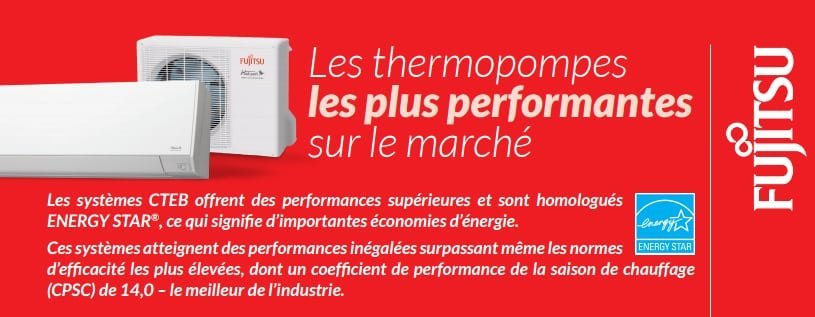
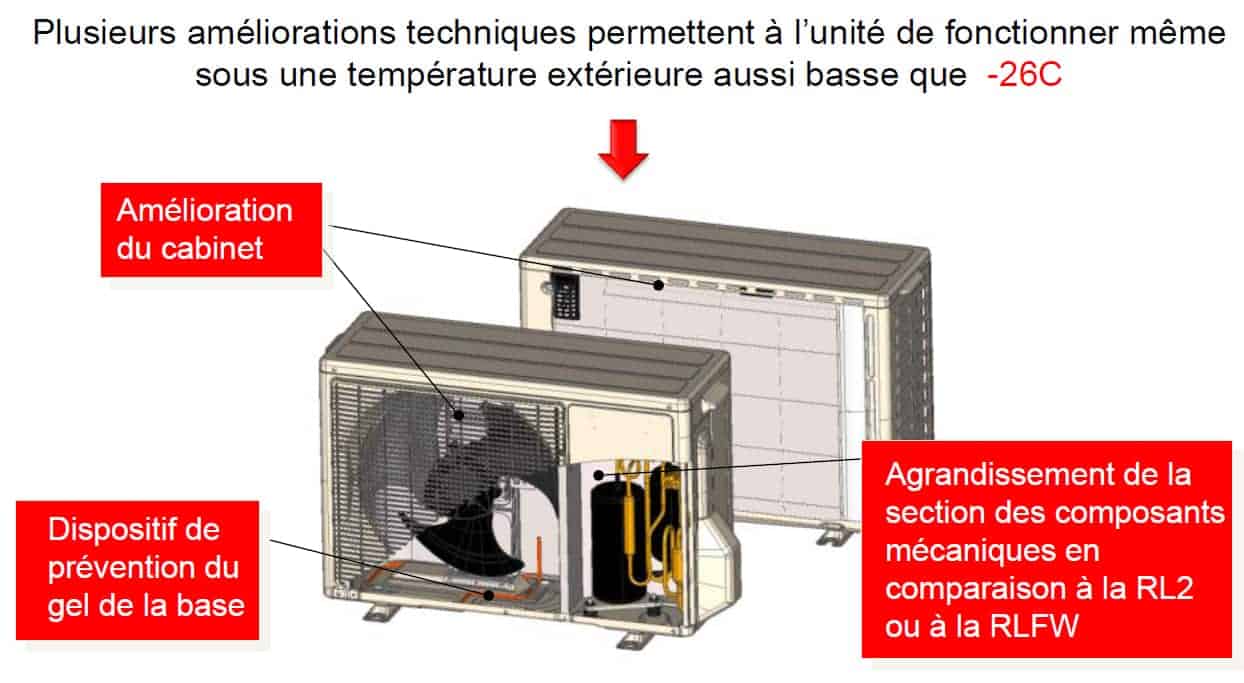
When winter temperatures reach extreme cold, you and your family must be able to count on an efficient and reliable system. Fujitsu’s CTEB series outdoor units have been designed to provide comforting and enveloping heat down to -26 ° C, which is lower than any other model on the market. Here’s how :
Protective metal grille
While the competition models are fitted with plastic grilles, the Fujitsu CTEB models are fitted with more robust metal grids, therefore more resistant to cold weather.
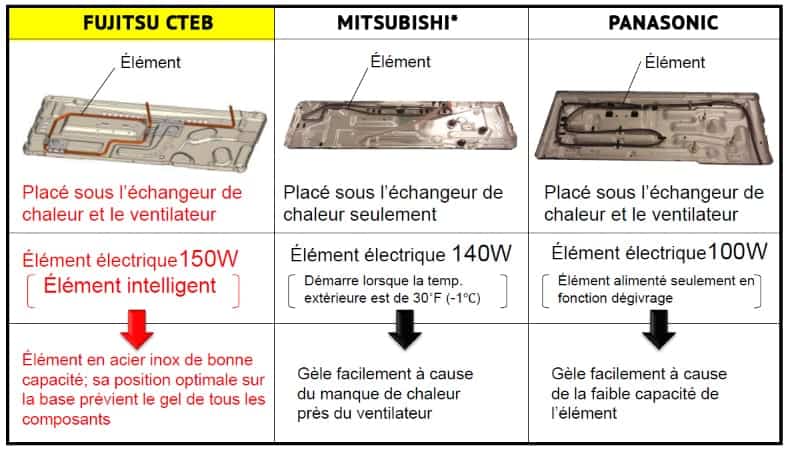
Heating element
When temperatures drop below freezing, the built-in heating element warms the base of the outdoor unit to prevent freezing of the condensate. Without a heating element, frozen condensate can generate noise, damage the condenser and fan blades, and further reduce system performance.
Multi-perforated drainage base
The base of the CTEB devices has multiple perforations allowing the drainage of the condensate melt water.
Rock-solid performance and superior energy savings
Fujitsu air conditioners are designed to save you a lot of energy. Given the constantly rising energy costs and long heating periods imposed on us by our Quebec climate, it makes perfect sense to choose the best device that can lower your electricity bills as much as possible.
Energy saving program
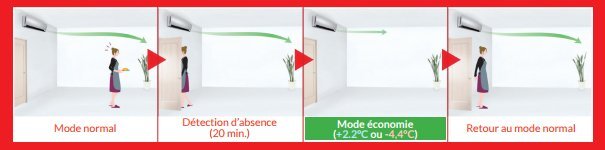
These Fujitsu Halcyon air conditioning and heating systems can save you money even when you forget. When you leave the room without switching off the appliance, the energy saving program (ESP) is activated and 20 minutes later, the selected temperature is increased by 2.2 ° C in air conditioning mode and reduced by 4.4 ° C in heating mode. When you return home, it returns to the previous operating mode and quickly to the programmed temperature. By preventing the device from operating unnecessarily, the detector saves energy without you having to think about it.
Fujitsu’s high power fan 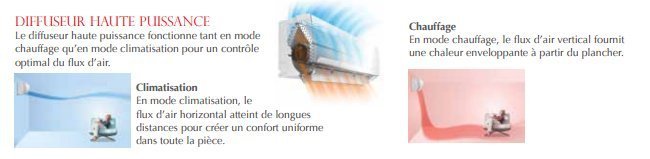
Automatic defrost CTEB
When the outside temperature is very low and the humidity level is very high, frost may form on the outdoor unit during the heating operation, and this may reduce the operating performance of the product. To protect the product against frost, this Fujitsu multi-zone heat pump is equipped with an automatic defrost function controlled by a microcomputer. In the event of frost forming, the air conditioner stops temporarily and the defrost circuit operates briefly (maximum 15 minutes). The indoor unit control lamp flashes during this operation. If frost forms on the outdoor unit after the heating operation, the outdoor unit will shut off automatically after operating for a few minutes. Then the automatic defrosting operation starts. 
Application of Fujitsu ductless wall heat pumps
Fujitsu wall-mounted heat pumps provide air conditioning in summer and heating in winter for unparalleled comfort all year round. The indoor and outdoor units are provided with DC motors (variable), superior performance and very quiet operation. These systems owe their unmatched performance to the high efficiency fan blades, evaporator and condenser paired with a Halcyon inverter variable speed compressor. The latter automatically adjusts the power of the appliance according to fluctuations in the demand for air conditioning or heating, for increased comfort in all seasons. Designed for individual rooms, these systems are the ideal solution for any space requiring air conditioning or heating. 
The best wall-mounted heat pumps on the market
As quiet as 21dB, Fujitsu wall-mounted heat pumps can be installed in any space of your home because they make no noise. Continuous ventilation will ensure your comfort throughout the year thanks to the low and high speed mode. Unlike centralized systems, Fujitsu wall-mounted air conditioners require no air ducts. So you have no energy losses, which could represent more than 30% of energy consumption. With efficiency up to 33 SEER (seasonal energy efficiency ratio), our Fujitsu air conditioning and heating systems rank among the most efficient on the market!
- Wireless remote control
- Apple catechin filter
- Deodorizing ion filter
- Night mode
- 24h programming
- Dehumidification mode
- Motorized shutters: up / down
- Automatic mode
- Economy mode
- Silent mode
- Automatic restart
- Automatic reverse
- Prevention of cold air flow temperature detector
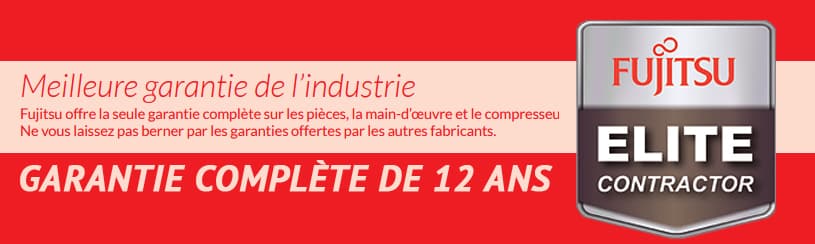
Rely on our Elite Dealer certified installers
Entrusting comfort to Fujitsu means ensuring year-round comfort, maximum performance when you really need it, and substantial energy savings. It is also the guarantee of a flawless installation guaranteeing the optimal performance of your system, because each Fujitsu system is installed by a certified retailer who has received specific technical training and who has all the skills required to recommend the device that best meets all of your comfort needs and criteria. This will establish its recommendation not only on the living area, but also on the insulation, fenestration, the number of occupants and your needs and lifestyle.

Reviews
There are no reviews yet.